Author: admin

  • How to Choose the Right LED Landscape Lighting Transformer: Sizing Guide for Contractors

    How to Choose the Right LED Landscape Lighting Transformer: Sizing Guide for Contractors

    Choosing the right LED landscape lighting transformer is one of the most critical decisions you’ll make for any outdoor lighting project. An undersized transformer causes voltage drop, flickering lights, and premature fixture failure. An oversized one wastes money and can reduce efficiency. In this guide, we’ll walk through exactly how to calculate the right transformer size for your landscape lighting system—whether you’re lighting a small residential garden or a sprawling commercial property.

    Why Transformer Sizing Matters

    In low-voltage landscape lighting (12V or 24V), the transformer is the heart of your system. It converts standard 120V household current down to a safe, efficient voltage for outdoor use. Getting the sizing right affects everything from light output and consistency to energy costs and equipment lifespan.

    According to the National Electrical Manufacturers Association (NEMA), undersized transformers are the #1 cause of landscape lighting system failures. When a transformer is overloaded, it generates excess heat, which degrades internal components and can create fire hazards.

    The Basic Formula: How to Calculate Transformer Size

    The standard calculation is straightforward:

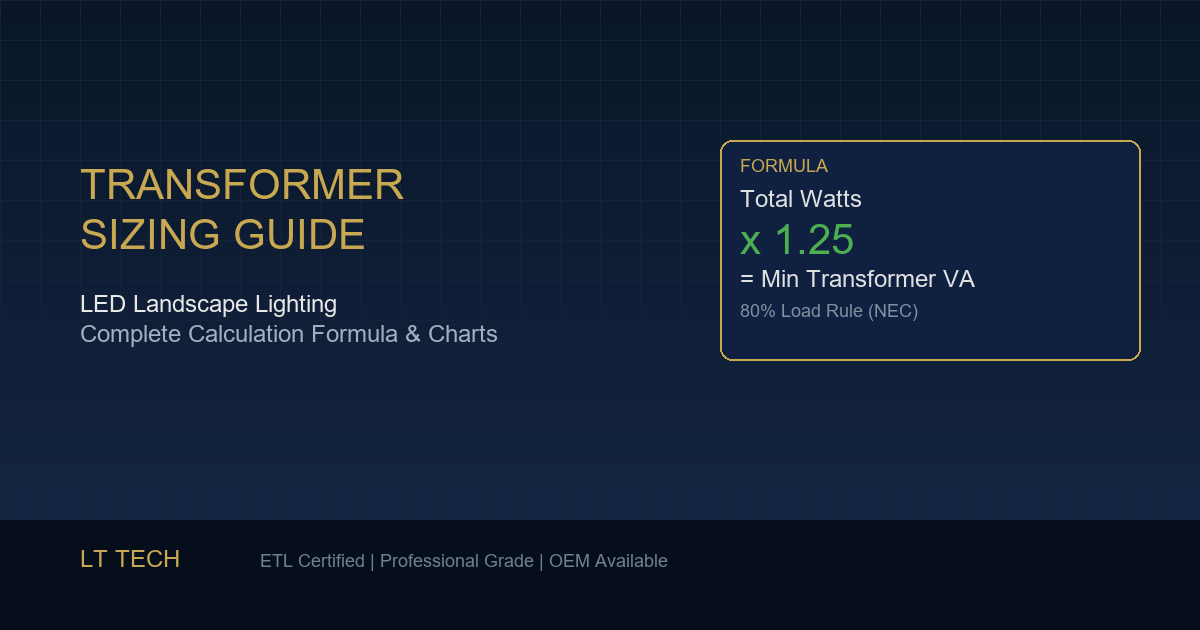
    Total Wattage × 1.25 = Minimum Transformer Capacity (in VA or Watts)

    The 1.25 multiplier (or 125%) is not arbitrary—it’s based on the National Electrical Code (NEC) requirement that transformers should not be loaded beyond 80% of their rated capacity for continuous loads. This 25% safety margin accounts for:

    • Inrush current surges when fixtures first power on
    • Voltage fluctuations in the power supply
    • Future additions to the lighting system
    • Thermal derating in hot climates

    Step-by-Step Calculation Example

    Let’s say you’re designing a landscape lighting system for a mid-size residential property:

    • 8 × Path Lights at 3W each = 24W
    • 4 × Spot Lights at 5W each = 20W
    • 3 × Flood Lights at 7W each = 21W
    • 2 × Well Lights at 4W each = 8W
    • 6 × Deck Lights at 2W each = 12W

    Total Wattage = 85W

    Apply the safety factor: 85W × 1.25 = 106.25W minimum

    In this case, you’d choose a 150W transformer (the next standard size up). Going with a 100W unit would leave no headroom, and a 300W unit would be overkill for this load.

    Understanding Transformer Ratings: Watts vs. VA

    You’ll often see transformers rated in either Watts (W) or Volt-Amps (VA). For LED lighting, these aren’t always interchangeable. The relationship depends on the power factor (PF):

    VA = Watts ÷ Power Factor

    High-quality LED drivers typically have a power factor of 0.9 or higher, meaning 100W of LED load requires approximately 111VA. Cheaper LED products may have power factors as low as 0.5, doubling the VA requirement. Always check the power factor specification when selecting a transformer for LED loads.

    12V vs. 24V Transformers: Key Differences

    If you’re deciding between 12V and 24V systems, the transformer choice follows suit. For a deeper comparison, check out our complete 12V vs 24V landscape lighting guide. Here’s a quick summary:

    Feature12V Transformer24V Transformer
    Typical Max Capacity300W–600W600W–1500W
    Wire Run DistanceUp to 50ft recommendedUp to 100ft+ recommended
    Fixture CompatibilityMost residential fixturesCommercial/long-run fixtures
    CostLowerHigher
    Voltage Drop SensitivityHigh (larger wire needed)Low (smaller wire OK)

    Multi-Tap Transformers: The Professional’s Choice

    Multi-tap transformers offer multiple voltage output terminals (typically 12V, 13V, 14V, and 15V). This is essential for compensating for voltage drop over long wire runs. Here’s how to use them effectively:

    • 12V tap: Use for fixtures within 25 feet of the transformer
    • 13V tap: Use for fixtures 25–50 feet away
    • 14V tap: Use for fixtures 50–75 feet away
    • 15V tap: Use for fixtures 75–100+ feet away

    By the time the voltage reaches distant fixtures, it will have dropped to approximately 12V—the ideal operating voltage for LED landscape lights. This ensures consistent brightness across your entire system.

    Common Transformer Sizing Mistakes

    1. Ignoring Inrush Current

    LED fixtures draw significantly more current during the first few milliseconds of startup (inrush current)—sometimes 50–100× their steady-state draw. While this surge is brief, it can trip breakers or cause intermittent issues if the transformer is already near capacity. Always factor in the 80% loading rule.

    2. Forgetting About Future Expansion

    Property owners almost always want to add more lights later. Sizing a transformer for only current needs means buying a second transformer—or replacing the first—when the client wants to add pathway lights or highlight a new tree. We recommend adding 10–20% extra capacity beyond the 25% safety margin for future expansion.

    3. Mixing LED and Halogen on the Same Transformer

    While technically possible, mixing LED and halogen fixtures on the same transformer creates problems. Halogen loads are resistive (power factor ≈ 1.0), while LED loads may have lower power factors. The combined load can cause inconsistent performance and may void the transformer’s warranty. If you must mix, calculate the total VA carefully, not just watts.

    4. Overlooking Ambient Temperature

    Transformers installed in direct sunlight or enclosed spaces (like a garage) in hot climates like Texas or Arizona must be derated. A transformer rated at 300W at 25°C (77°F) may only deliver 240W at 40°C (104°F). Always check the manufacturer’s temperature derating curve.

    Quick Reference: Transformer Sizing Chart

    Total LED WattageRecommended Transformer SizeHeadroom %
    0–60W75W25%
    61–96W150W (120W usable)25%
    97–160W200W25%
    161–240W300W25%
    241–400W500W25%
    401–600W750W25%
    601–960W1200W25%

    ETL Certification: Why It Matters for Transformers

    When selecting a transformer for outdoor use, ETL certification is non-negotiable. ETL-listed transformers have been independently tested for safety, including overload protection, thermal shutdown, and weather resistance. Using non-certified transformers can void insurance claims and may violate local building codes.

    All LT Tech transformers are ETL certified and designed specifically for the North American market, with multi-tap options and built-in photocell timers.

    Installation Best Practices

    • Mount the transformer at least 12 inches above ground to prevent water intrusion
    • Use weatherproof enclosures rated NEMA 3R or higher for outdoor installations
    • Keep wire runs as short as possible from transformer to first fixture to minimize voltage drop
    • Install a surge protector between the power source and transformer to protect against lightning and power spikes
    • Label each circuit on the transformer for easy troubleshooting later
    • Test voltage at the farthest fixture after installation—it should read between 10.8V and 12.0V for a 12V system

    LT Tech Transformer Solutions

    At LT Tech, we offer a complete range of ETL-certified landscape lighting transformers designed for professional installers:

    • LT-TF75: 75W, single-tap 12V, ideal for small residential projects
    • LT-TF150: 150W, multi-tap (12V/13V/14V), our most popular model
    • LT-TF300: 300W, multi-tap with built-in timer and photocell
    • LT-TF600: 600W, commercial-grade with dual output zones

    All models feature stainless steel enclosures, thermal overload protection, and come with a 5-year warranty. Contact our team for volume pricing and OEM customization options.

    Frequently Asked Questions

    Can I use a larger transformer than needed?

    Yes, but with caveats. A transformer that’s significantly oversized (e.g., 600W for a 50W load) will still work, but it may have higher no-load power consumption and lower efficiency at low loads. As a rule of thumb, don’t exceed 4× your actual wattage when oversizing.

    Do LED landscape lights need a special transformer?

    LED lights require either an LED-compatible magnetic transformer or an electronic transformer. Older magnetic transformers designed for halogen may cause LED flickering because they have minimum load requirements that LED fixtures don’t meet. Always choose a transformer specifically rated for LED loads.

    How many LED lights can I put on one transformer?

    Divide the transformer’s usable capacity (80% of rated wattage) by the wattage per fixture. For example, a 150W transformer has 120W usable capacity. With 3W LED path lights, that’s up to 40 fixtures. Always leave room for voltage drop and future additions.

    Where should I mount my landscape lighting transformer?

    Mount it outdoors near a GFCI-protected outlet, at least 12 inches above ground, in a shaded location if possible. Avoid mounting in direct sunlight or in areas where sprinklers will hit it. The transformer should be within 5–10 feet of the power source to minimize line-side voltage drop.

    Need help sizing your transformer? Contact LT Tech for free project consultation and custom transformer recommendations for your landscape lighting installation.
  • 12V vs 24V LED Landscape Lighting Systems: A Complete Comparison for Professionals

    12V vs 24V LED Landscape Lighting Systems: A Complete Comparison for Professionals

    Choosing between 12V and 24V landscape lighting is not just a technical decision – it affects your material costs, installation labor, wire sizing, and long-term system performance. Whether you are designing a residential garden path or a sprawling commercial campus, getting the voltage right from the start saves time and money.

    In this guide, we compare 12V and 24V low-voltage LED landscape lighting systems across the factors that matter most to professionals.

    The Basics: Why Low Voltage?

    Both 12V and 24V systems fall under the NEC Article 411 classification for low-voltage landscape lighting. Compared to line-voltage (120V) systems, low-voltage lighting offers:

    • Safer installation — No risk of fatal electric shock; most jurisdictions don’t require a licensed electrician
    • Flexible placement — Cables can be buried shallowly (6″ vs. 24″ for line voltage)
    • Lower material cost — Smaller transformers, lighter gauge wire
    • Easier maintenance — Simpler troubleshooting and component replacement

    The question is: which low-voltage standard is right for your project?

    12V Systems: The Industry Standard

    Advantages

    Universal Compatibility. The vast majority of residential and commercial landscape lighting fixtures are designed for 12V operation. This means maximum product availability and design flexibility. From path lights to spotlights, underwater fixtures to hardscape accents — if it exists in landscape lighting, there’s a 12V version.

    Transformer Availability. 12V transformers are widely available in every wattage range (20W to 900W+), from every major manufacturer. Replacement and upgrade are straightforward.

    Established Ecosystem. With decades of market dominance, 12V has the largest installed base, the most fixture options, and the most experienced installer community.

    Limitations

    Voltage Drop. The #1 challenge with 12V systems. Over long cable runs, voltage decreases due to wire resistance. At 11V, LED fixtures may flicker or dim; below 10V, they may not operate at all. This means:

    • Shorter maximum cable runs (typically 50–100 ft on 12AWG before significant drop)
    • Thicker wire required for longer runs (10AWG or even 8AWG)
    • Multiple home runs or hub wiring strategies needed for large properties

    Higher Current. For the same wattage, 12V systems draw twice the current of 24V systems (P = V × I). Higher current means thicker wire, more heat at connections, and more careful attention to wire nut and splice quality.

    24V Systems: The Growing Alternative

    Advantages

    Reduced Voltage Drop. Doubling the voltage halves the current, which means voltage drop is significantly less severe over the same wire gauge and distance. Practical impact:

    • Cable runs 2–3× longer on the same wire gauge
    • Thinner wire (14AWG or 12AWG) can cover distances that would require 10AWG or 8AWG at 12V
    • Fewer home runs needed on large commercial properties

    Material Cost Savings. On large installations, the wire savings alone can be substantial. A 500-run commercial project might save 30–40% on wire costs by using 24V instead of 12V.

    Cleaner Installations. Fewer transformers, fewer home runs, and thinner cables mean less trenching, fewer junction boxes, and faster installation.

    Limitations

    Limited Fixture Selection. Fewer 24V-native landscape fixtures are available. Many 24V installations use 12V fixtures with step-down converters or multi-tap transformers — adding complexity and potential failure points.

    Transformer Compatibility. Not all landscape transformers offer 24V output. You’ll need to select specific models or use commercial-grade power supplies.

    Mixed-Voltage Risks. On projects that combine 12V and 24V zones, installers must be extremely careful not to connect 12V fixtures to 24V circuits — this will immediately destroy the LED drivers.

    Head-to-Head Comparison

    Factor12V24V
    Fixture Availability★★★★★ Extensive★★★☆☆ Limited
    Max Cable Run (12AWG)~50–100 ft~150–250 ft
    Wire Cost (large project)HigherLower (30–40% savings)
    Transformer Options★★★★★★★★☆☆
    Residential Suitability★★★★★★★★☆☆
    Commercial Suitability★★★★☆★★★★★
    Installation Simplicity★★★★★★★★☆☆
    Voltage Drop SeverityHighLow
    SafetyExcellentExcellent

    Which Should You Choose?

    Choose 12V When:

    • Project is residential or small commercial (< 200 ft total run)
    • Maximum fixture variety is important
    • You want the simplest installation with universal parts availability
    • Your team is experienced with 12V and you don’t want retraining

    Choose 24V When:

    • Project is large commercial (campus, HOA, municipal)
    • Cable runs exceed 150 ft and you want to avoid thick wire
    • Wire cost savings are a priority
    • You’re working with a lighting designer who specifies 24V fixtures

    Hybrid Approach:

    Many experienced installers use a hybrid strategy — 24V for long home runs from the transformer to remote zones, then step down to 12V at the fixture group. This combines the best of both worlds but requires careful planning and labeling.

    LT Tech: 12V Specialists with OEM Flexibility

    At LT Tech, our core product line is built around the 12V standard — the most widely deployed system in the U.S. landscape lighting market. Every fixture in our catalog (path lights, spotlights, flood lights, in-ground/well lights, deck lights, hardscape lights, underwater lights) is engineered for reliable 12V operation with minimal voltage drop sensitivity.

    For distributors and OEM partners requiring 24V configurations, we offer custom driver specifications and tailored product solutions. Our in-house engineering team can adapt any fixture in our catalog for 24V operation while maintaining ETL certification compliance.

    Explore our full range of ETL-certified 12V landscape lighting, or contact us to discuss custom OEM/ODM specifications for 24V projects.


    Need help specifying the right system for your next project? Our technical team is available to review layouts, calculate voltage drop, and recommend the optimal configuration — at no charge for qualified projects.

  • ETL Certification Guide for Landscape Lighting: What Contractors Need to Know in 2026

    ETL Certification Guide for Landscape Lighting: What Contractors Need to Know in 2026

    ETL Certification Guide for Landscape Lighting: What Contractors Need to Know in 2026

    ETL Certification Guide for Landscape Lighting: What Contractors Need to Know in 2026

    When you’re specifying landscape lighting for a commercial project or recommending products to a homeowner, one question always comes up: “Is this product certified?”

    For contractors, distributors, and specifiers in the United States, ETL certification isn’t just a nice-to-have — it’s often a code requirement. In this guide, we’ll break down what ETL certification means for landscape lighting, why it matters for your business, and how to verify that the products you buy meet the standard.

    What Is ETL Certification?

    ETL (Electrical Testing Laboratories) is a Nationally Recognized Testing Laboratory (NRTL) certified by OSHA. Products bearing the ETL mark have been tested and found to comply with applicable safety standards — for landscape lighting, this typically means UL 1838 (Low-Voltage Landscape Lighting Systems) and UL 2108 (Low-Voltage Lighting Systems).

    In plain terms: the ETL mark tells inspectors, insurance companies, and your clients that the product won’t catch fire, short out, or create a shock hazard when installed correctly.

    Why ETL Certification Matters for Your Projects

    1. Code Compliance

    Most jurisdictions in the U.S. require listed (certified) electrical products for both residential and commercial installations. The National Electrical Code (NEC) Article 411 explicitly covers low-voltage landscape lighting systems and references listing requirements. Installing non-certified products can result in:

    • Failed inspections
    • Project delays and costly rework
    • Potential liability if an incident occurs

    2. Insurance and Liability

    Insurance adjusters and legal teams pay close attention to product certifications after an incident. If a fire or electrical failure is traced back to a non-certified product, the installer and distributor can face significant liability. ETL certification provides a defensible layer of protection.

    3. Client Confidence

    When you present a product lineup with ETL-certified options, you’re signaling professionalism and reliability. For high-end residential and commercial projects, this is a competitive differentiator — especially when bidding against contractors who cut corners on certification.

    4. Distributor Requirements

    Many lighting distributors and big-box retailers require ETL or UL listing before they’ll stock a product. If you’re a wholesaler or distributor, carrying certified products opens doors to larger accounts and retail partnerships.

    ETL vs. UL: What’s the Difference?

    This is one of the most common questions we hear. Both ETL and UL are NRTLs recognized by OSHA — the certifications are legally equivalent. The key differences:

    FactorETLUL
    Recognized by OSHA✅ Yes✅ Yes
    Testing StandardSame (UL 1838, UL 2108)Same
    Inspection ProcessPeriodic factory inspectionsPeriodic factory inspections
    Turnaround TimeGenerally fasterCan be slower
    CostOften lowerOften higher

    Bottom line: ETL and UL marks carry the same legal weight. What matters is that the product is listed by a recognized NRTL — not which specific mark it carries.

    How to Verify ETL Certification

    Don’t just take a supplier’s word for it. Here’s how to verify:

    1. Check the product label — Look for the ETL mark with the control number
    2. Search the Intertek database — Visit intertek.com/marks/etl and search by manufacturer or model number
    3. Request the test report — Reputable manufacturers can provide the full test report upon request
    4. Ask for the Listing Report — This document specifies exactly which models and configurations are covered by the certification

    Red Flags: When to Walk Away

    Be cautious if a supplier:

    • Claims certification but can’t provide documentation
    • Shows a “pending” certification that never seems to be completed
    • Substitutes certified products with uncertified variants without notice
    • Has certifications that only cover a narrow subset of their product line

    A trustworthy manufacturer maintains certification across their full product range and makes documentation readily available.

    LT Tech’s Commitment to Certified Quality

    At LT Tech, every 12V LED landscape lighting product in our catalog carries ETL certification, along with FCC and RoHS compliance. We believe certification isn’t a marketing checkbox — it’s a fundamental responsibility to the contractors, distributors, and end-users who rely on our products.

    Our certifications cover the full range: path lights, spotlights, flood lights, in-ground lights, deck lights, hardscape lights, underwater lights, and transformers. When you source from LT Tech, you can verify every model — and we’ll provide the documentation to back it up.

    Ready to source certified landscape lighting? Contact our team to request product catalogs, certification documents, or OEM/ODM pricing.


    This article is for informational purposes and does not constitute legal or engineering advice. Always consult local codes and a licensed electrician for project-specific requirements.